[:en]Outsport Final Conference : Project results, final considerations, recommendations, follow-up and perspectives[:it]Conferenza finale di Outsport – risultati del progetto, considerazioni finali, raccomandazioni e prospettive di follow up[:]
[:en]
DOWNLOAD THE PRESS KIT
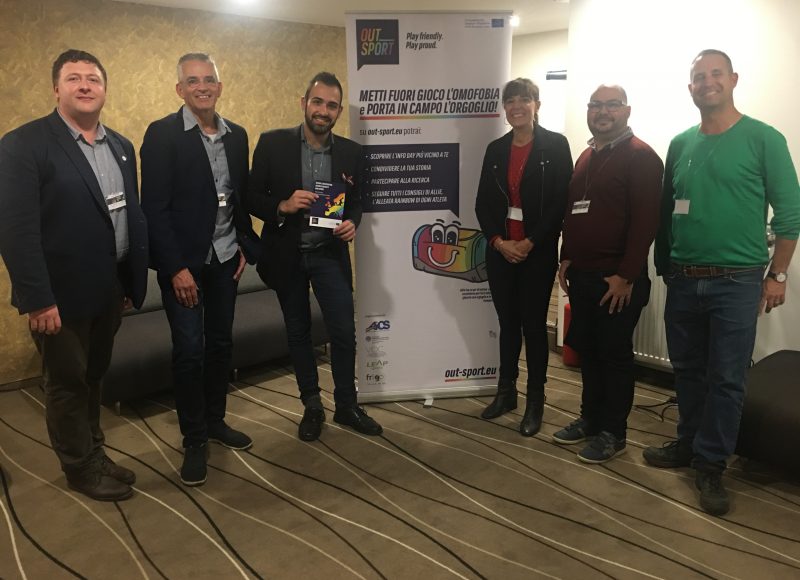
The 8th of November 2019, the Outsport Final Conference took place in Budapest. It was the final step of a 3 years-long innovative and challenging project co-financed by the European Commission through the Erasmus Plus program on “Innovative and educational approaches to prevent violence and tackle discrimination in sport based on sexual orientation and gender identity”. The project was coordinated by AICS (Italian Association for Culture and Sport) with key partners from Scotland (LEAP sports), Germany (German Sport University, Cologne), Austria (VIDC) and Hungary (Frigo).
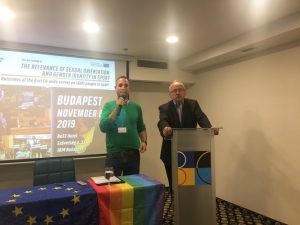
Gabor Lazlo (Frigo) with Niedermuller Péter, the newly-elected mayor of Budapest 7th district
The participants received welcome and greetings by Péter Niedermüller, the newly-elected mayor of the 7th district of Budapest.
Opening the works of the conference, Marisa Fernández Esteban, Deputy Head of the Sport unit, Directorate-General for Education, Culture, Youth and Sport of the European Commission. “We have a mandate to create a new dimension of sport, as it is time to stop considering it as mere competition. Social innovation and inclusion are among the main virtues of sport, and projects like these need and deserve our support.
Addressing homophobia and transphobia in sport through scientific research, communication and training can really help us create more resilient and inclusive societies. Also, this pedagogical approach can help in the creation of other projects that strive to find new educational tools to be used against exclusion, hatred, racism and discrimination.”
During the conference, the two main Outsport outcomes have been presented:
1) Final Report on the EU-wide research on the experiences of LGBTI people in sport coordinated by the German Sport University of Cologne. It is now available on our website www.out-sport.eu, and contains the aggregated data results at EU level, highlighting the differences regarding sexual orientation and gender identity between the five project countries (Italy, Germany, Scotland, Hungary and Austria) and all the other EU member states, exposing a rich and wide perspective of anti-LGBTI attitudes in sport and in different sport disciplines and environments, as lived and perceived by LGBTI people.
More than 5,500 lesbian, gay, bisexual, transgender and intersex (LGBTI) people from all 28 EU countries completed the online survey. Almost 90% of respondents consider homophobia and particularly transphobia in sport a current problem. 20% refrain from participating in a sport of interest due to their sexual orientation and/or gender identity. 16% of respondents who are currently active in any sports have had at least one negative personal experience in the last 12 months that was related to their sexual orientation or gender identity. The share is higher among trans people – especially among trans women (46%). Based on these survey findings, umbrella organisations and federations from the 5 projects countries have been interviewed about their strategies in tackling homo-/transphobic discrimination in the field of sport. These data have been used to produce 5 specific focus booklets for each country (Austria, Germany, Hungary, Italy, Scotland) with local highlights and recommendations to their national sport institutions.
Foldi Lazlo, Training of Trainers expert
2) A pedagogical toolkit to address LGBTI inclusion in and through sport. Outsport aims to promote a new inclusive training approach: apart from contrasting homophobia and transphobia in sport, Outsport strives to make sport a tool to educate against any form of exclusion and a chance to develop social competencies in continuity with the school. On this front, the second main outcome is the publication of the Training Toolkit, a manual for those working in sport and education with exercises and practices tested during the project and based on the Non-Formal Education through Sport methodology (moveandlearn.org).
All partner organizations and participants activists agreed on the importance of introducing a specific focus in the next European Work Plan for Sport – contrasting homo-transphobia and gender stereotypes. This would also enhance the debate on “gender equality”.
Concrete policies on SOGI discrimination in sport could be very useful to contrast homo-transphobia and gender stereotypes.
In accordance with the first guiding objective of the current EU Work Plan for Sport, “to ensure, through cross-sectoral cooperation, the awareness of other EU policy domains of the contribution that sport can make in meeting the policy challenges facing the EU” project partners recommend the Working Party on Sport of the Council of the European Union: a) to include LGBTI issues and SOGI discrimination in the guiding objectives of the next EU Work Plan for Sport; b) to promote the enhancement the existing sport education programs with trainings on SOGI discrimination and LGBTI rights issues; c) to open up a dialogue with all relevant stakeholders (EU and COE Institutions, associations, NGOs) who can contribute to the development of such policies.
Outsport coordinator, Rosario Coco commented: “After the project results these recommendations are a key political challenge in order to produce a concrete impact on European sport policies from grassroots to professional levels”.
The partners finally agreed on the importance of giving continuity to the work on this topic launching next objectives and new follow-up strategies. In particular, it was considered strategic to develop the scientific part of the project to deepen the knowledge of discrimination based on gender identity and sexual orientation in Europe, but also to obtain a dynamic picture of the phenomenon and the impact policies have on it.
The training toolkit, booklets, pictures and more from the final conference are available on our website at the following link.[:it]
Conferenza finale di Outsport
risultati del progetto, considerazioni finali, raccomandazioni e prospettive di follow up
L’8 novembre si è tenuta a Budapest la conferenza finale di Outsport. È stato l’ultimo passaggio di un progetto co-finanziato dalla Commissione Europea attraverso il programma Erasmus plus su “approcci innovativi ed educativi per prevenire la violenza e contrastare la discriminazione basata su identità di genere e orientamento sessuale”. Tre anni ricchi di sfide e di importanti risultati. Il progetto è stato coordinato da AICS – Associazione Italiana Cultrua e Sport e ha avuto partner chiave dalla Scozia (LEAP sports) dalla Germania (German Sport University, Cologne), dall’Austria (VIDC) e dall’Ungheria (Frigo).
I partecipanti alla conferenza sono stati accolti dai saluti del neo eletto sindaco del VII distretto di Budapest Niederm?ller Péter.
In apertura dei lavori l’importante intervento di Marisa Fernández Esteban, a capo della Sport Unit, del Directorate-General for Education, Culture, Youth and Sport della Commissione Europea. “Progetti come Outsport – ha detto Esteban – che puntano a contrastare omofobia e transfobia nello sport attraverso la ricerca scientifica, la comunicazione e la formazione, ci aiutano a creare società più inclusive e resilienti. Outsport si impena a fare dello sport uno strumento contro ogni forma di esclusione e una possibilità di sviluppare le competenze sociali in continuità col ruolo della scuola. Il rapporto scientifico dettagliato è uno strumento di grande valore che sottolinea le differenze rispetto all’orientamento sessuale e all’identità di genere e offrono un’ampia prospettiva degli atteggiamenti anti-Lgbti nello sport e nei diversi ambienti e discipline sportive, così come sono vissuti e percepiti dalla stesse persone Lgbti”.
Nel corso della Conferenza sono stati presentati i due principali risultati di Outsport:
1) Il rapporto finale della prima ricerca a livello europeo sull’esperienza delle persone Lgbti nello sport, coordinata e curata dalla German Sport University di Colonia. È adesso disponibile sul nostro sito internet www.out-sport.eu e contiene i dati aggregati a livello di Unione Europea, sottolineando poi in particolare le differenze rispetto a orientamento sessuale e identità di genere tra i cinque Paesi del progetto (Italia, Germania, Scozia, Ungheria e Austria) e gli altri Paesi UE, rappresentando un’ampia e ricca prospettiva della esperienze anti-Lgbti in Europa.
Più di 5.500 persone lesbiche, gay, bisessuali, transgender e intersessuali da tutti i 28 Paesi UE hanno completato il questionario online. Quasi il 90% dei rispondenti considera l’omofobia e ancor più la transfobia nello sport un problema attuale. Il 20% rinunciano a partecipare a uno sport di interesse a causa dell’orientamento sessuale e/o dell’identità di genere. Il 16% dei rispondenti attualmente attivi nella pratica sportiva hanno subito almeno un personale esperienza negativa collegata all’orientamento sessuale o all’identità di genere negli ultimi 12 mesi. Un percentuale che sale al 46% per la donne trans MtoF.
Sulla base di questi risultati sono stati intervistati rappresentanti qualificati di federazioni sportive o organizzazione sportive ombrello dei cinque Paesi del progetto, sulle rispettive strategie nel contrasto delle discriminazioni omo-transfobiche nello sport. Queste informazioni qualitative sono state utilizzate per la produzione di cinque opuscoli focalizzati su ciascun Paese coinvolto (Austria Germania, Ungheria, Italia e Scozia) con i dati più rilevanti a livello locale e le specifiche raccomandazioni per le istituzioni sportive e nazionali.
2) Un manuale pedagogico per affrontare l’inclusione delle persone Lgbti nello sport e attraverso lo sport. Outsport punta a promuovere un nuovo approccio formativo inclusivo. Oltre a contrastare omofobia e transfobia nello sport, l’obiettivo è rendere lo sport stesso un potente strumento di educazione contro ogni forma di esclusione e una opportunità di sviluppare competenze sociali in continuità con la scuola. Su questo fronte il nostro secondo grande risultato è la pubblicazione del Training Toolkit, il manuale di formazione dedicato ad allenatori, formatori, insegnanti di educazione fisica, dirigenti e tutti coloro che lavoro nell’ambito sportivo e dell’educazione, che contieni esercizi e altri consigli testati nel corso del progetto e basati sulla Non-Formal Education Trough Sport methdology (moveandlearn.org).
Tutte le organizzazioni partner del progetto sono concordi nel ritenere fondamentale l’introduzione di un focus specifico nel prossimo European Work Plan for Sport per contrastare l’omotransfobia e gli stereotipi di genere. Un passaggio necessario anche per sviluppare il dibattito più generale sull’eguaglianza di genere nello sport.
Politiche concrete sulla discriminazione per orientamento sessuale e identità di genere nello sport potrebbero essere molto utili per contrastare omo-transfobia e stereotipi di genere che colpiscono l’ambiente sportivo nel complesso e non solo le persone Lgbti.
In linea con il primo obiettivo guida dell’attuale Piano Europeo per lo Sport che punta “ad assicurare, attraverso la cooperazione intersettoriale, la consapevolezza degli altri ambiti delle politiche europee del contributo che lo sport può offrire per affrontare le sfide che l’UE ha di fronte”, i partner del progetto raccomandano al Working Party on Sport del Consiglio dell’Unione Europea di: a) includere esplicitamente le questioni relative alle persone Lgbti e alla discriminazione basata su orientamento sessuale e identità di genere tra gli obiettivi chiave del Prossimo Piano Europeo per lo Sport; b) di sostenere l’inclusione nei programmi educativi sportivi di specifiche formazioni sulla discriminazione per orientamento sessuale e identità di genere e sui diritti delle persone Lgbti; c) di avviare un dialogo con tutti i soggetti interessati (istituzioni UE e nazionali, federazioni sportive, associazioni e ONG) che possano contribuire allo sviluppo e all’implementazione di queste politiche.
Il coordinatore di Outsport, Rosario Coco ha commentato: “Immediatamente dopo i risultati di questo progetto, queste raccomandazioni sono una sfida politica chiave per produrre un impatto concreto sulle politiche dello sport in Europa a tutti i livelli dalle organizzazioni amatoriali alla pratica professionistica”.
I partner, infine, condividono sull’importanza di dare continuità al lavoro avviato su questo tema lanciando i prossimi obiettivi e strategie per continuare e sviluppare ulteriormente l’impegno progettuale. In paricolare è stato considerato strategico sviluppare la ricerca e la parte scientica del progetto per approfondire la nostra conoscenza sulla discriminazione basata su orientamento sessuale e identità di genere in Europa e per ottenere un’immagine dinamica dell’evoluzione e del cambiamento del fenomeno e dell’impatto delle eventuali politiche messe in campo.
Il nostro Trainng Toolkit, gli opuscoli della ricerca per i cinque paesi del progetto, le fotografie e gli altri materiali della conferenza finale dono disponibili per il download dal nostro sito internet al seguente link. http://www.out-sport.eu/wp-content/uploads/2019/11/OUSPORT-FINAL-CONFERENCE-PRESS-KIT-.zip.
Press Office
Andrea Maccarrone
andymaccarrone@gmail.com
+39 3497355715[:]