This is not about fairness: the Hailey Davidson case

Golfing Beyond Sport, Science, and Politics
Scottish-American pro golfer Hailey Davidson has filed a lawsuit against the LPGA and USGA after being barred from competition following a 2024 rule change that effectively excludes trans women from élite golf.
As reported by Them, Davidson — who began her transition after puberty and underwent gender-affirming surgery in 2021 — is suing the organisations on anti-discrimination grounds.
The 2024 policy requires athletes to be assigned female at birth or transition before puberty. This change excluded her from competition and took away a hard-earned qualification opportunity.
The Lawsuit
The lawsuit claims:
“Both organizations exerted an incredible amount of control over Hailey’s ability to play the game she loved and her personal medical information in an effort to unlawfully control her participation in women’s golf,” adding:
“The USGA and LPGA preyed on Hailey’s love of the game and desire to play to get the precise medical information that would allow them to exclude her from the sport. The USGA and LPGA acted as one when it came to ensuring that Hailey Davidson would be banned from women’s golf.”
Hailey Davidson: A Career On Hold
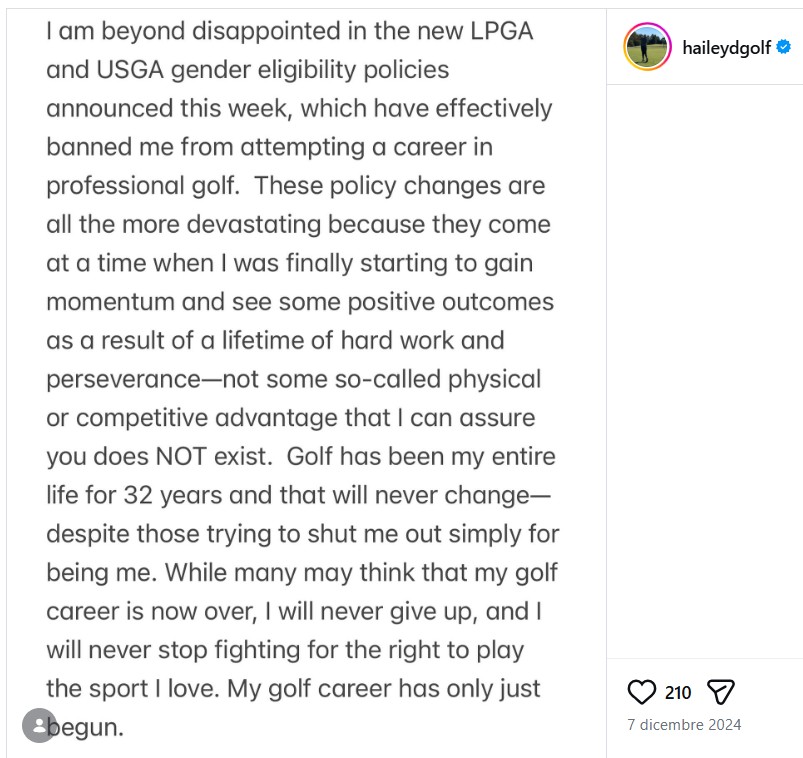
In a now-deleted Instagram post from December 2024, Davidson described the situation as
“the greatest achievement I’ve earned in my life taken from me.”
She had just qualified for the Epson Tour in 2025 — but cannot compete under the new rules.
The Third Category Trap
Davidson has also filed a separate lawsuit against NXXT Golf over a similar eligibility change.
The organization reportedly offered her a place in a hypothetical third category, which she declined.
NXXT will be defended in court by America First Legal, the legal firm founded by Donald Trump adviser Stephen Miller, which has already moved to dismiss the case.
Why the “third category” doesn’t work
Let’s be clear.
- There are not enough trans athletes to sustain competitive categories at elite level
- Women’s sport is already underfunded, underrepresented, and undervalued
- A separate structure risks becoming symbolic rather than viable
- A new category doesn’t address the issue of abuse against women and girls — cis or trans
The Policy Shift
As reported by Golf Monthly in late 2024, the controversy did not emerge overnight.
Upon retirement in Spring 2024, the 34-year-old Independent Women’s Forum (IWF) ambassador Amy Olson publicly stated that it was “not right” for transgender athletes to compete in the LPGA. Olson signed a letter joined by other players such as Olivia Schmidt, who also participated in the promotion of a trans-exclusionary documentary series by IWF called ‘Tee Time: Keep Women’s Golf Female’ — reflecting a broader backlash within the sport.

This marks a significant shift from the LPGA’s earlier position.
In 2010, the organization changed its participation policy to allow trans-identified male golfers to compete in the women’s division, stating that the move would “assure fair competition for all members and participants.”
The contrast between the two policies shows how dramatically the governing approach has evolved — from inclusion to restriction.
Science vs Policy
Policies excluding trans athletes are often justified in the name of “fairness” and science.
We already talked about how the third category is, in fact, a trap. Now, let’s talk science.
The most recent systematic review and meta-analysis published in the British Journal of Sports Medicine found that there is no clear presumption of advantage for transgender women, challenging the very foundation on which many of these policies are built.
The study highlights that existing data are mixed, limited, and far from supporting blanket exclusion policies.
In fact, some findings suggest that transgender women may even show lower performance in certain metrics.
The Gap We Can’t Ignore
There is a gap between policy and evidence we cannot ignore.
Framing it as “science-based regulation” risks becoming policy built on selective interpretation of scientific evidence.
At the same time, these decisions unfold within a broader political context where sport becomes a battleground for ideological agendas rather than a space grounded in consistency and rights.
This is not about fairness. It’s about control.
The IOC turn: back to sex testing
This broader shift is not limited to golf.
The International Olympic Committee is now moving toward reintroducing genetic sex testing and tightening access to the women’s category — a major reversal.
In 1996, the IOC discontinued universal sex testing because it was considered scientifically inaccurate, ethically unjustifiable, and harmful to athletes.
Today, those same practices are returning under a different framing.
Global Backlash: over 100 organisations speak out
A coalition including the Sport & Rights Alliance, ILGA World, Humans of Sport and more than 100 organisations (including Outsport) has condemned the move.
Their position is clear:
- sex testing is invasive, harmful, and discriminatory (it doesn’t apply to men!)
- it exposes women athletes to public scrutiny and bodily policing
- it risks setting sport back decades
Such policies do not protect women — they harm all women and girls, especially those who do not conform to narrow expectations of femininity.
These measures also disproportionately affect athletes from the Global South and reinforce patterns of racialised scrutiny in sport.
Read and join the statement here.
Segregation Rebranded as Inclusion
Similarly to what has happened to other trans athletes — such as Lia Thomas and her erased achievements — this case is not happening in a vacuum.
If we don’t want to remain passive spectators of outrageous episodes like the forced genital inspection of the entire Swedish National Football Team in 2011, this is our chance to make noise.